

Veteran's Home header graphic
New Hampshire Veterans Home banner
New Hampshire Veterans Home - an official New Hampshire Government website
Smaller text size Reset text size Larger text size

Resident-Centered Care

Vision

A veteran's chosen home and community, where caring is assured, friendships surround, and good lives go on.

Mission

The mission of the New Hampshire Veterans Home is to provide high quality, professional, long-term care services to the Granite State's elderly and disabled veterans with compassion, respect, and dignity.

Philosophy of Care

Patrolling the hallways

We believe that each Resident is a unique individual, worthy of dignity and respect regardless of age, race, color, religion, disease, or illness.

We believe that each Resident should have a place to call his/her own, in a warm homelike environment that promotes safety, enjoyment, and privacy.
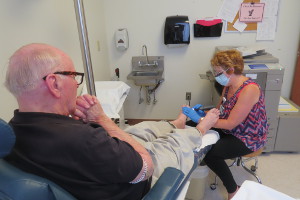
We believe that each person's individuality must be respected. Therefore, decisions about a Resident's daily life will be made with him or her or with the individual(s) acting under an activated Durable Power of Attorney for Health Care or guardianship.

We believe that independence is a desirable human quality that fosters a sense of well-being. Each Resident will be encouraged and assisted in attaining the highest level of independence and self-care that is possible for him or her to achieve.

The NHVH staff at a Care-Plan Meeting

We believe that the function of a long-term care facility is to maintain and/or improve the physical and mental health of our Residents.

We believe in a holistic, interdisciplinary approach to Resident care and that family, friends and volunteers are integral members of our Care Planning Team.

We believe in the personal growth and satisfaction of staff members through their work and consider that the provision of a comprehensive orientation program, continuing education, and recognition for individual and group efforts helps to promote satisfaction.

We believe that each member of our staff contributes essential knowledge, skills, experience, and personal attributes to the quality of care provided.

We believe that death is the final stage of growth, and a palliative approach to care is essential when life can no longer be sustained.

Guiding Principles

Arthur checking on the flower garden
  • Recognize that all employees are vital to the success of our mission. Employees will also be treated with the same compassion, dignity, and respect as our residents.
  • Ensure an optimal quality of life for the New Hampshire Veterans Home residents.
  • Create a community of trust and opportunity where everyone's contributions are valued.
  • Foster learning and growth to help realize everyone's individual and collective aims, hopes, and aspirations.
  • Maintain a stable, safe, and secure environment for all.
  • Uphold the spirit and intent of RSA 119, the Home's enabling legislation.

Quality of Life

In 2007, the New Hampshire Veterans Home was one of the first nursing homes in the State of New Hampshire to win a Quality of Life Award from the Department of Health & Human Services. NHVH was recognized again in 2009 by DHHS for its continuing commitment to nursing home culture change and quality of life.

According to DHHS, "the Quality of Life Awards recognize and celebrate culture change efforts. There is a national movement underway to grow a new culture among nursing homes: a culture that improves quality of life through transforming a facility into a home, a patient into a person, and a schedule into a choice."

The Quality of Life Award focuses on:

  • Resident Care and Choice - Restoring to residents as much control, choice and normalcy as possible.
  • Staff Empowerment - Creating management and practices that enhance front line staff's capacity to be responsive to residents.
  • Home Environment - Creating a meaningful relationship between the person and his/her living environment to establish a home.
  • Community Involvement - Embracing family and community members into a shared partnership of supporting and caring for residents.
A typical room in the women's wing

Culture Change: Transforming the New Hampshire Veterans Home

When Anne Howe, RNC, MSN, introduces herself as "Director of Resident Care Services," it's often a conversation stopper-until she adds the subtitle, "Director of Nursing," and then people nod their heads up and down. But Anne keeps introducing herself as Director of Resident Care Services because, she says, "It's an uphill battle and we're going to win. At the Veterans Home we are working to move away from the strictly clinical model of nursing. We want to integrate many disciplines into the care of each resident. After all, if you focus only on the clinical, you can lose a person's soul-you watch their joy of living disappear."

This transformation, or "culture change" movement, affects everything: from the time residents get up (or choose to sleep in) to the foods they eat, the activities they participate in, and the type of housing in which they live. "It's been a tug-of-war," Howe says, "because traditional nursing home regulations have been at odds with resident-centered care."

At NHVH the disciplines of nursing, social work, recreation, dietary, and rehabilitation are being integrated into what we call "the Care Team." The Care Team focuses on the whole person, not just the effects of a stroke, the damaged lungs, or elevated blood sugar. Howe adds, "People trust us when they bring a loved one to our Home. Most of the time it will be their last home, so we have a huge responsibility to make it a habitat for living-not a waiting room for death. We need to address all the parts-not just the physical parts-that make a person a human being."

The good news is that traditional nursing home regulations are beginning to change. Homes for elders are placing decision-making powers where they should be: in the hands of the residents. Nursing homes with long corridors of identical rooms, shared bathrooms, and regimented schedules that were designed for the convenience of staff-not for the comfort of residents-are being renovated or rebuilt to create "neighborhoods" (similar to LEDU, our Life Enhancement Dementia Unit) and "households," where single rooms, private bathrooms, small "family" dining areas, and unobtrusive nurses' workstations create an environment that says "home," not just "home-like."

In a column in the Boulder City News, Gary Bermeosolo, administrator of the Nevada State Veterans Home-Boulder City, said "Both the Department of Veterans Affairs and the Centers for Medicaid and Medicare, two agencies charged with regulating care in nursing homes, are embracing cultural change and, in fact, are considering dramatic changes to their regulations to encourage it."

He adds, "Think about how you live in your own home and realize that this is what most nursing home residents really want and what our cultural change is all about."

Howe is a member of the New Hampshire Veterans Home Master Plan Committee. "We are going to be proactive about our future", she says. "We are looking at the challenges that will need to be addressed in the next 20 to 25 years and we are making sure our recommendations are consistent with culture change. We have always been a place where our staff cares deeply about our residents; now we are raising the bar even higher. We say it and we mean it: this is our residents' home - we just work in it."

New Hampshire Veterans Home
139 Winter Street  |  Tilton, NH 03276-5415  |  
(p) 603-527-4400  |  (f) 603-527-4402